
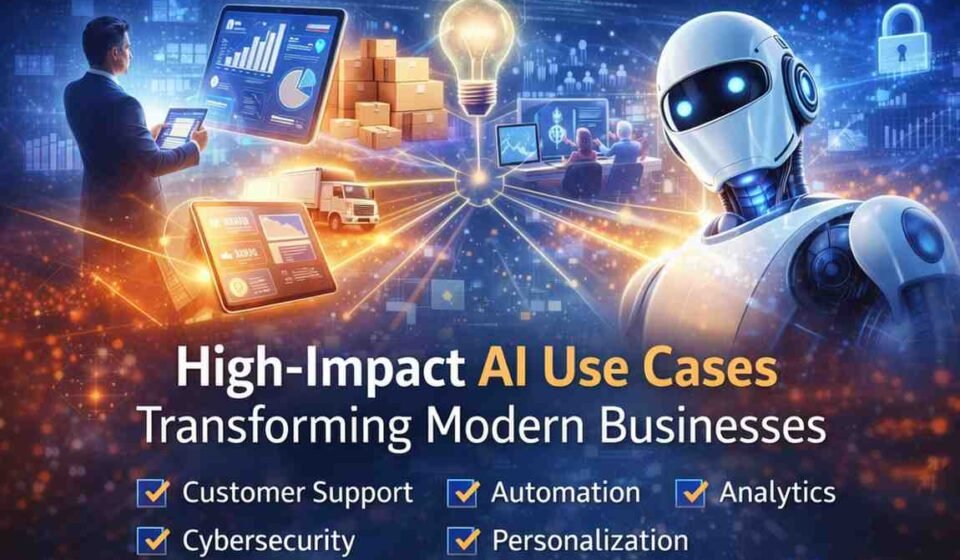
High-Impact AI Use Cases That Are Transforming Modern Businesses in 2026
Artificial Intelligence has moved beyond experimentation. In 2026, organizations are no longer asking “What can AI do?” but instead “Where does AI create measurable value?”
Table Of Content
- 1. Customer Support Automation That Improves Satisfaction and Reduces Cost
- 2. Personalized Customer Experience at Scale
- 3. Intelligent Document Processing (IDP)
- 4. Predictive Analytics for Better Decision-Making
- 5. AI-Powered Sales and Marketing Optimization
- 6. Code Generation and Developer Productivity
- 7. AI in HR: Smarter Hiring and Workforce Insights
- 8. Cybersecurity and Fraud Detection
- 9. Process Automation in Operations (AIOps & RPA + AI)
- 10. AI-Assisted Product Design and Innovation
- 11. Supply Chain and Logistics Optimization
- 12. Knowledge Management and Internal Search
- Why These Use Cases Matter
- How to Identify the Right AI Use Case for Your Business
- Final Thoughts
The difference is important.
Many companies tried AI pilots that looked impressive but delivered little business impact. The winners today are those applying AI in specific, high-leverage areas where it reduces cost, saves time, improves decisions, or increases revenue in a measurable way.
This article focuses only on value-driven AI use cases—practical applications that businesses are using right now to gain a competitive advantage.
1. Customer Support Automation That Improves Satisfaction and Reduces Cost
AI chatbots and voice assistants are no longer simple FAQ responders. Modern conversational AI systems understand intent, sentiment, and context.
Business value:
24/7 customer support without increasing headcount
Faster response time
Reduced ticket volume for human agents
Consistent customer experience
AI systems now resolve common issues, route complex cases to the right agent, and even summarize conversations for support teams.
2. Personalized Customer Experience at Scale
AI analyzes customer behavior, preferences, and past interactions to deliver highly personalized recommendations.
Business value:
Increased conversion rates
Higher customer retention
Improved average order value
Better engagement across apps and websites
This is widely used in e-commerce, streaming platforms, fintech apps, and SaaS products.
3. Intelligent Document Processing (IDP)
Businesses deal with invoices, contracts, forms, emails, and reports daily. AI can read, extract, classify, and validate information from these documents automatically.
Business value:
70–90% reduction in manual data entry
Fewer human errors
Faster processing of invoices, claims, and applications
Significant operational savings
Industries like banking, insurance, healthcare, and logistics benefit heavily from this.
4. Predictive Analytics for Better Decision-Making
AI models analyze historical and real-time data to predict outcomes such as demand, churn, fraud, or equipment failure.
Business value:
Smarter inventory planning
Reduced downtime with predictive maintenance
Fraud detection before losses occur
Accurate demand forecasting
This turns data into actionable intelligence rather than static reports.
5. AI-Powered Sales and Marketing Optimization
AI identifies which leads are most likely to convert, what content works best, and when customers are ready to buy.
Business value:
Higher ROI on marketing campaigns
Better lead scoring
Improved email targeting and ad performance
Increased sales productivity
Sales teams spend time on high-value prospects instead of cold outreach.
6. Code Generation and Developer Productivity
Developers now use AI assistants to write, review, refactor, and debug code.
Business value:
-
Faster development cycles
-
Reduced bugs
-
Easier legacy code modernization
-
Higher engineering productivity
This is especially valuable for startups and tech teams working with limited resources.
7. AI in HR: Smarter Hiring and Workforce Insights
AI screens resumes, schedules interviews, analyzes employee performance data, and predicts attrition risks.
Business value:
Faster hiring process
Reduced hiring bias
Better employee retention strategies
Data-driven performance insights
HR becomes strategic instead of administrative.
8. Cybersecurity and Fraud Detection
AI continuously monitors systems to detect unusual patterns, intrusions, or fraudulent activities in real time.
Business value:
Early threat detection
Reduced financial loss from fraud
Improved system resilience
Automated incident response
This is critical for fintech, banking, and enterprises handling sensitive data.
9. Process Automation in Operations (AIOps & RPA + AI)
AI combined with automation tools handles repetitive operational workflows such as ticket routing, system monitoring, and data synchronization.
Business value:
Reduced operational overhead
Faster issue resolution
Optimized cloud and infrastructure costs
Improved system uptime
IT teams can focus on innovation rather than maintenance.
10. AI-Assisted Product Design and Innovation
Generative AI helps teams create product designs, prototypes, marketing creatives, and even new product concepts.
Business value:
Faster product development
Reduced design cost
Rapid experimentation with ideas
Shorter time to market
This is widely used in manufacturing, retail, and digital product companies.
11. Supply Chain and Logistics Optimization
AI predicts delays, optimizes routes, and manages inventory dynamically.
Business value:
Lower logistics cost
Fewer stockouts and overstocks
Faster delivery times
Smarter warehouse management
Especially important for e-commerce and manufacturing.
12. Knowledge Management and Internal Search
AI allows employees to find answers from internal documents, emails, and knowledge bases instantly.
Business value:
Less time spent searching for information
Faster onboarding for new employees
Better knowledge sharing across teams
Large organizations save thousands of work hours annually.
Why These Use Cases Matter
These are not experimental ideas. They are AI applications directly linked to:
Revenue growth
Cost reduction
Time savings
Risk mitigation
Productivity improvement
That is why businesses investing in these areas see clear returns.
How to Identify the Right AI Use Case for Your Business
Ask these questions:
Where are humans doing repetitive work?
Where do errors frequently occur?
Where do delays impact customers?
Where is data available but underused?
Where do decisions rely on guesswork?
These are prime opportunities for AI.
Final Thoughts
AI delivers the most value when applied to real business problems, not as a trend or experiment. Organizations that focus on value-driven AI use cases are seeing measurable improvements across departments.
The future of AI in business is not about replacing humans—it is about amplifying human capability with intelligent systems.
Companies that adopt these practical AI applications today will build faster, smarter, and more efficient operations for tomorrow.